Search

Tuesday, April 5, 2022

Argentine journalist calls Bolivian vice-consul a "delinquent" and embassy announces actions

In one of her programs, journalist Viviana Canosa accused the diplomat of appropriating land in the municipality of La Matanza.
 
The Argentine journalist Viviana Canosa, host of the program "Viviana con vos", of the A24 channel, called the Bolivian Vice Consul in Buenos Aires Mauricio Pinaya a "delinquent", whom she blamed for the blockade on the Riccheri highway. In response, the Embassy of the Plurinational State of Bolivia in Argentina announced that it will file a complaint for defamation.

Background information shows that on April 1, journalist Canosa referred to the blockade suffered by those living near the Riccheri highway -which connects to the municipality of La Matanza- and accused the Bolivian vice-consul of having "usurped" the land.

"The Bolivian vice-consul usurped land and apart from that he wants them to pay for the services, to connect the electricity, it's a joke. Go back to Bolivia, vice-consul, and stop breaking your balls," said Canosa.

"Bring him to me and I will teach him how to pay taxes, go back to Bolivia, don't be a delinquent, you are squandering land that is not yours and on top of that you are cutting the highway", he continued.

In a statement, the Embassy of Bolivia in Argentina expressed its concern and pointed out that these are xenophobic and discriminatory expressions.

"The Embassy of Bolivia in Argentina, through the corresponding channels, will present before the respective instances the formal complaints for defamations to the Bolivian personnel accredited in this country," said a statement issued on Monday.

It added that the complaint will also be filed against lawyer Florencia Arietto, who last March 31, through her Twitter account, accused the Bolivian consular authority of the blockade on the Riccheri highway, "lacking the truth and denting the dignity of a representative of Bolivia in Argentina." 

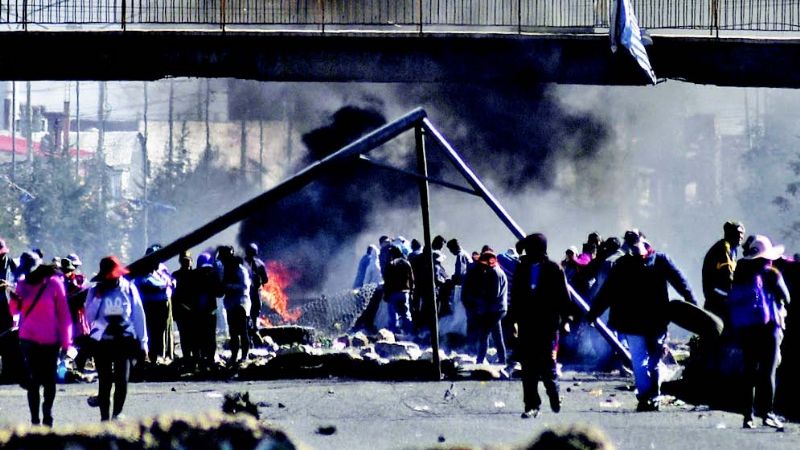
The Bolivian journalist in Buenos Aires Marcelo Orellana reported this Tuesday to Página Siete Digital that the neighbors who live in the area Barrio Puente 13, with a majority presence of Bolivian residents, installed last Wednesday blocking points on the Riccheri highway in protest for the cutting of electric power and removal of wiring.

"The municipality came and cut our cable. We are suffering an outrage from the municipality, we are 720 families who live here and we are not going to move, we demand that they put the light back on," said a Bolivian resident.

"We are Bolivians, but our children are Argentines, we have no electricity or water, we have access to water from pumps", said another Bolivian woman to TV Radio La Nueva.

Vice Consul Pinaya went to the place, talked for a few minutes with the Bolivian residents and left the place, local media reported. The blockade was lifted on Thursday last week. 

Wednesday, March 30, 2022

Drug planes released by Davila were still flying with cocaine shipments

 Of the 66 sealed aircraft, there are planes that Dávila had released after cancelling a mega-operation in 2019. The same planes were also found with other shipments and there are also some with cloned and erased license plates. Several defendants were sent to Palmasola.

Investigations by the Special Force to Fight Drug Trafficking and the Anti-Narcotics Prosecutor's Office reveal that of the 66 aircraft sealed in the operation this past Sunday at the La Cruceña airfield, in the Cotoca area, several of them turned out to be the same ones that on July 30, 2019 also fell on that runway in a mega-operation with arrests and a shootout. In that episode everything was annulled by order of the then national chief of the Felcn, Maximiliano Dávila Pérez, now imprisoned in the San Pedro prison in the city of La Paz.

After Sunday's operation, 38 people were arrested, 40 hangars were seized and 66 aircrafts were sealed, in addition to the seizure of firearms, ammunition, equipment, satellite phones, vehicles and others.

The Controlled Substances Prosecutor's Office, headed by prosecutors Freddy Guzmán and Carlos Candia, charged the 38 detainees with trafficking, conspiracy, criminal association and possession and carrying of firearms.

The Prosecutor's Office concludes by requesting imprisonment for all of them and specifies that some of the detainees have even been charged for oral trial for drug trafficking. In its main part, it specifies that three airplanes have a history of drug trafficking.

The released narco aircrafts

In a cautionary hearing, in the Felcn hall, in front of the 38 apprehended, the Prosecutor's Office informed Judge Estrella Montaño, the background of these aircrafts. The vessels in question are CP-2535, CP-2906 and CP-3084. The prosecutors assure that these ships were located in hangars 8 and 11, and that according to investigations by Felcn reports they were already found with drugs.

CP-2535 was caught with drugs on a runway in Montero, and also fell with cocaine during an operation in Santa Ana de Yacuma-Beni.

The same happens with CP-2906, which is registered in two cases of cocaine cargo transport in Santa Cruz. The vessel CP-3084 also appears to have been intercepted on two occasions loaded with cocaine in Santa Cruz.

The investigations point out that these ships, curiously register in the Felcn report of the case SC-X-611/19, which corresponds to July 30, 2019, diligence that was annulled, with the change of reports and statements by order of Maximiliano Dávila Pérez.

Cloned and erased license plates

The Prosecutor's Office argued before Judge Estrella Montaño that at the La Cruceña airfield, which should comply with the rules of lawful operations, flagrant crimes were being committed all the time.

Airplanes with cloned and erased license plates were detected and thus operated in drug trafficking activities.

In front of the judge, the prosecutors, with the help of reports made by Felcn agents, detailed that some of the detainees already had previous records, as they were arrested in previous mega-operations carried out at the airfield.

For example, Glober Soleto Guzmán and Luis Mauricio Lora Aguilera, the first one accused for oral trial for the crime of trafficking, was on Sunday at the airfield where he was arrested. Luis Mauricio Lora Aguilera, is listed as detained in another operation at the aerodrome on November 21, 2019.

According to the Prosecutor's Office and the Felcn, most of the 38 arrested this Sunday at the aerodrome, also fell in the mega-operations of July 30, 2019 and November 21, 2019.

Almost 5,000 liters of gasoline

During Sunday's action Felcn and the Prosecutor's Office seized 4,870 liters of aviation gasoline in drums. According to the prosecutor's analysis, the fuel was manipulated to supply planes for flights to clandestine airstrips transporting quantities of drugs, as well as precursors, food, and implements for crystallization laboratories.

Early this morning during the hearing, Judge Estrella Montaño ordered the detention in Palmasola of several of the 38 people, among them Glober Soleto Guzmán and Luis Mauricio Lora Aguilera, the first one already accused for oral trial for trafficking, but who was at liberty. All of them remained silent before the Prosecutor's Office and the judge. For the Prosecutor's Office, the evidence presented was overwhelming. 

Narcoavionetas

Silala: after Evo's unfulfilled threat, Chile advances its lawsuit

 Six years after Chile initiated the lawsuit against Bolivia in the International Court of Justice (ICJ), which seeks to ratify the international character of the waters of the Silala, this Friday the oral arguments between the two countries begin in The Hague. These will determine whether or not Bolivia has full sovereignty over the flow of the waters initiated in the country.

With an approximate length of 56 kilometers and an altitude of 4551 meters above sea level, the waters of the Silala are located in the Andean altiplano area, between the department of Potosí in Bolivia and the Antofagasta region of Chile.

According to an investigation carried out by the civil engineer and environmentalist Antonio Bazoberry and called "The Silala Myth", in 1904 the prefecture of Potosí granted a concession so that the Antogasta Bolivia Railway (FCAB) could build artificial channels and take advantage of the waters for its operation.

In this regard, Professor of International Law Sergio Castro explained that the prefecture of Potosí, through a supreme decree, annulled the concession in the 90's and Bolivia warned of cutting off the waters of the Silala. Chile responded with a possible military intervention.

During 2002, the Bolivian Ministry of Foreign Affairs publicly denied the existence of bilateral negotiations related to the waters of the Silala. Bolivia stated that the waters did not flow naturally to Chile and belonged exclusively to it. Through a communiqué, it announced the interruption of the flow of the waters to Chile or the initiation of an international lawsuit before the ICJ.

From 2006 to 2010, the governments of Evo Morales and Michelle Bachelet worked on a 13-point bilateral agenda, which included an agreement for the use of the waters of the Silala. This was made available to Potosí through a referendum, which attempted to add the payment of a historical Chilean debt for the use of the Silala without prior authorization. The decision was rejected by the neighboring country.

"The Chileans not only make an abusive and arbitrary use of our Silala waters, but they also do some more actions, they are drilling wells at 300, 400 meters so that their mining companies can take advantage of these subway waters", denounced in 2016 the former foreign minister and current vice president of Bolivia David Choquehuanca, who was part of the national delegation in the work of the bilateral agenda.

In March 2016, former President Evo Morales, in his protocol speech for the Day of the Sea, advanced that the country would go to the ICJ to denounce that Chile was "stealing waters from the department of Potosí".

"We have decided, as a pacifist country, that we are going to go to The Hague so that Chile respects our waters of the Silala in the department of Potosí. We are with legality, we are with international law, however, yesterday Chile through an authority answers us, tells us that no, that it is an international river", indicated at that time Morales.

Alerted by the statements, in June 2016, Chile files a lawsuit against Bolivia in The Hague. Subsequently, in August 2018, Bolivia responded with a counterclaim and counter-memorial before the ICJ.

Chile alleges that the Silala is an international river and Bolivia that it is a spring originating in its territory. Oral arguments will be held from April 1 to 14, 2022.

 Chile knew how to take more advantage of the Silala than Bolivia did.

The professor of International Law, Sergio Castro, indicated that the waters of the Silala are mainly used by companies in the north of Chile, in the region of Antofagasta, bordering the Bolivian border.

"It is not only used by companies, but also for the consumption of people and for agriculture in certain areas. The Silala is a development pole for Chile," he assured.

In 2016, the then Chilean Minister of Foreign Affairs, Heraldo Muñoz, reported that the waters of the Silala were used by two companies: Ferrocarril Antofagasta Bolivia, belonging to the Luksic group, and by Codelco Chuquicamata division.

The former captures a total of 120 liters of water per second, while the latter captures 150 liters of water per second.

On the other hand, Bolivia in 2012 tried to implement a fishing zone, a dam and a mineral water bottling plant.

For Castro, it is very difficult for the country to take full advantage of the spring waters, due to its geographical position. He explained that the waters are located under two hills, approximately 700 meters above sea level, and a mechanism would have to be created to eliminate the distance.

Another option is to create tunnels to give passage from the Silala to Potosí. "Technically it is possible, but it would be a large investment", he assured.

Chile sues Bolivia before the ICJ in The Hague.

Chilean agent Ximena Fuentes filed the application for registration of the lawsuit against Bolivia in The Hague on June 6, 2016, stating that the Silala was an international river and Chile could also take advantage of its waters.

Bolivia responds with a counterclaim

Former President Evo Morales reported on August 31, 2018 that Bolivia had filed a counterclaim and counter-memorial before the International Court of Justice for the lawsuit initiated by Chile two years ago.

"Studies carried out confirm that a considerable flow flows artificially towards Chile due to works carried out in the last century," the former president assured on his Twitter account.

Start of oral arguments between Bolivia and Chile

After two years of the suspension of oral arguments due to the pandemic, the International Court of Justice announced, on March 9, the schedule of oral arguments between Bolivia and Chile in the Silala case.

 They will begin on Friday, April 1 and will conclude on April 14.

Chile requests that the Silala be declared an international river and that it has equitable use of the waters. Bolivia indicates that it is a spring that arose in the country.  

Chile advances its lawsuit

Tuesday, March 29, 2022

Silala: Bolivia admitted that waters also have international course

  A communiqué of the Ministry of Foreign Affairs of February 2020 informed that Bolivia admitted, in the counter-memorial presented before the International Court of Justice (ICJ), that part of the waters of the Silala flow naturally towards Chile. With this criterion, the former Bolivian agent before the court in The Hague Eduardo Rodríguez Veltzé and the current Chilean agent Ximena Fuentes agree separately.

In an interview to Los Tiempos, Rodríguez Veltzé affirmed that the scientific results on the disputed waters were characterizing the Silala "as an international watercourse". Meanwhile, Fuentes declared last week to CNN that the country changed its position during the development of the process and ended up accepting that the Silala is a river of international course.

The statement of the Foreign Ministry, then in charge of Karen Longaric, clarifies that the litigation before the ICJ began during the government of Evo Morales and in their "procedural acts" (counter-memorial) they admit that part of the waters of the Silala flows naturally to Chile.

The pleadings in the Silala dispute between Chile and Bolivia begin this April 1 at the Peace Palace in The Hague and will continue for the next 14 days.

According to Rodríguez Veltzé, "as reported to the Chancellery and the relevant authorities, the results of the scientific work and its contrast were revealing a high percentage of coincidences on the characterization of the Silala as an international watercourse according to the definition and characteristics of the repeated UN Convention. These findings and other aspects, such as the treatment of the works as canals that artificially alter the flow towards Chile, marked the terms of the answer, the counterclaim and its consideration for the judicial or extrajudicial understandings that attend the controversy".

For Fuentes, Bolivia recognizes that Chile is somewhat right when it replies (in the counter-memorial) and in reality what it wants to say is that "I recognize that it is an international river that, effectively, due to the slope of the terrain, these waters, which, effectively, are born from springs and then form a river that naturally crosses the border and enters Chilean territory. Up to that point one could have said that the Silala case is over, because the Chilean position was accepted by the counterpart", detailed Fuentes.

Spring or river?

Chile filed on June 6, 2016, under the second government of Michelle Bachelet, a lawsuit against Bolivia before the ICJ for it to declare that the Silala is an international watercourse and that Chile, as a riparian, has the right to the use of its waters.

 However, Bolivia's initial position was that the waters of the Silala are natural springs that were artificially diverted by Chile.

Andrónico will not travel to The Hague

The president of the Senate, Andrónico Rodríguez, informed that he will not travel to The Hague to attend the hearings at the International Court of Justice on the Silala. He assured that Bolivia maintains its position that the disputed waters are not an international river as stated by Chile.

"We have mentioned and we assure that it is not an international river, but that its waters come from springs located in Potosí (...), which flow down to the towns of northern Chile, through artificial canalizations", said Rodríguez.

The legislator insisted on the issue: "We are sure that the origin of the waters is a spring, it is not an international river".

Silala

MAS deputies used textual information from Wikipedia for "defenders of democracy" bill

The project is in the Constitution Commission. The drafters are Congressmen María Alanoca and Zacarías Laura.

The bill proposed by two deputies of Movimiento Al Socialismo (MAS) that declares the inhabitants of Senkata, Sacaba, Montero, Betanzos, Ovejuyo and Pedregal as defenders of democracy, due to the conflicts of 2019, in the justifications part contains excerpts from Wikipedia and the text of an opinion article from Le Monde.

The copy of the quotations is inserted in the part of background and justification, and several spelling errors are evident. In the section entitled: "Sacaba mourned its dead for the massacres of the Government of Facto and in Defense of Democracy", the first two paragraphs are faithful copies from Wikipedia.

"On November 15, a strong contingent of coca growers' groups sympathetic to MAS tried to enter the city of Cochabamba. During the confrontations with the police, the security forces of that country seize a large amount of money, firearms and explosives from these protesters, supporters of the Movimiento al Socialismo (sic)," details the text of the MAS bill, according to ANF report.

The bill is before the Constitution, Legislation and Electoral System Commission of the Chamber of Deputies. The drafters are MAS deputies María Alanoca and Zacarías Laura.

The following reads: "After several confrontations with the police, six deaths and 115 wounded were reported. On the 16th of that same month, the Minister of Government, Arturo Murillo, stated that most of the deaths came from the demonstrators themselves. Proof of this is that the Bolivian Institute of Forensic Investigations (IDIF) confirmed that the eight protesters were killed by 22 and 9 mm caliber firearms and some were shot in the back while confronting the authorities. None of these calibers corresponded to the regulation weapons of either the military or the police, casting doubt on the qualification of these as 'massacres'," reads the text of the law profile.

Both paragraphs are excerpts from Wikipedia that are published in the article Massacres of Sacaba and Senkata. The free encyclopedia recalls the events that took place in November 2019, when Evo Morales resigned from the presidency and then Jeanine Añez took over.

Another paragraph of the MAS bill says: "While new elections could have allowed the country to decide if, and how, it wanted to turn the page regarding the Morales era, Bolivia is right now governed by Añez, an ultra-fundamentalist senator close to Camacho, who has proclaimed herself president. She has surrounded herself with soldiers, leaders linked to racist organizations and employers' representatives. None of them has been elected to the office they hold. This is called a coup d'état. 

This text is an excerpt from an opinion article by Ranaurd Lambert, December 2019, published in Le Monde, entitled A coup d'état too easy in Bolivia.

The proposed rule of the pro-government legislators provides in its sole article: "The city of El Alto, Senkata, Sacaba, Montero, Betanzos, Ovejuyo and El Pedregal are declared Defenders of Democracy of the year 2019, which sought to be snatched by extreme right-wing groups".

This legal body profile pretends to be based on four international reports, but does not mention the Interdisciplinary Group of International Experts (GIEI), which concluded that there were indeed massacres and extrajudicial executions. 

senkata


Monday, March 28, 2022

Daddy Yankee includes Bolivia in his farewell tour

 The Puerto Rican artist will perform in Santa Cruz de la Sierra on September 23. 

Daddy Yankee, one of the biggest names in the reggaeton industry, announced last week that his album "Legendaddy" would be his last and that he would say goodbye to a musical career of more than two decades with a concert tour called "La última vuelta". In the last hours, the Puerto Rican singer gave more details about this project and revealed that Bolivia is part of his last goodbye. 

"Last Friday we went out with the pre-sale of La última vuelta and it sold out in less than two hours. Tomorrow it goes on pre-sale in more cities and we repeat Miami", informed the rapper in his social networks.

Along with the message he shared an image informing about the next destinations, where he will visit Santa Cruz de la Sierra on September 23rd. 

According to his itinerary, Santa Cruz would be the first destination of the artist in South America, after his visit to the United States and before singing in places like Santiago de Chile, Buenos Aires and Bogota. 

No further details are yet known about the location of the concert or ticket prices. 

"This race, which has been a marathon, I can finally see the finish line. Now I'm going to enjoy with all of you what you have given me, what you have given me," said Raymond Ayala, the Puerto Rican singer's first name, in the video in which he announced his farewell.

"I retire with the greatest gratitude, my audience, my colleagues, all producers, radio, press, television, digital platforms and you, who have been with me from the 'underground', from the root, from the beginning of reggaeton," he said. 

Daddy Yankee started his musical career in the album "Playero 34", by music producer DJ Playero, where the word reguetón or reggaeton was heard for the first time. With his vision of taking the genre to another level, he continued to participate in other productions and joined in a duet with Nicky Jam, releasing his album, "Haciendo escante".

However, the duo broke up, giving Daddy Yankee the opportunity to release in 2004 the album "Barrio Fino", which included "Gasolina", a song that exploded the career of the legendary reguetonero. Daddy Yankee went on to release several albums, including "El Cartel: The Big Boss", "Mundial" and "Prestige".

The artist is no stranger to Bolivian audiences, having come on at least two occasions, in 2009 and 2018.  
Daddy Yankee includes Bolivia

Jeanine Añez's oral trial suspended until April 4

 The Court declared William Kaliman, Jorge Fernández, Sergio Orellana and Yuri Calderón in default. There were protests and decompensation of the former president.

This Monday, the oral trial against former interim president Jeanine Añez, for the so-called "coup d'état II" case, was scheduled to begin. However, in the midst of interruptions, technical problems and the decompensation of the former head of state, the suspension was determined until April 4.

"It has been a hearing that has skipped all kinds of procedures, there were many violations to my mother's rights. She was in very bad health, she has a very strong nervous crisis, however, they were installing the hearing in spite of everything", expressed Carolina Ribera, Añez's daughter.

"It was not that they suspended it because of my mother's health. They committed a series of irregularities and the court has decided to suspend the hearing for next week, April 4", she added. 

In the images of the virtual hearing, it could be seen how Añez was in discomfort and was being attended to by the health personnel of the Miraflores prison. While the doctors were doing their job, defense attorney Norka Cuéllar asked - unsuccessfully - for the judge to speak. In the end, Añez was taken out of the courtroom from where she witnessed the trial. 

"For an hour, former president Jeanine Añez was present virtually from the prison, listening to the Attorney General's Office instructing the Court how to conduct the illegal process. She had a crisis, verified by medical personnel in situ... The Court pretends trial without her!", wrote Añez's entourage in her official account.

"The defense of Jeanine Añez denounces a serious health crisis of the former president, who is being attended by medical personnel at the Miraflores prison. Outside the prison, groups armed with firecrackers and defamatory slogans are coercing and violating her", says the publication.

Defense attorney Luis Guillén affirmed that the court did not "adequately" comply with some procedures regarding the declaration of default of General Williams Kaliman and other three co-defendants, and that was the reason for the suspension.

The court declared four defendants in absentia: former commander Kaliman, former commander Jorge Fernández, former head of the Armed Forces Sergio Orellana and former police commander Yuri Calderón. 

The Ministry of Justice and Transparency issued a statement in which they assured that the government authorities "are respectful of due process". They also accused Añez's defense of obstructing the case and warned that the interruption of a trial for "unjustified" reasons constitutes the crime of delaying justice. 

"The problems caused to interfere in the virtual hearing and the excessive use of procedural resources by the defendant and his lawyers, reflect an obstructive attitude and contrary to the constitutional right to have judicial decisions in a reasonable time and without delays," the brief states. 

"Despite this attitude of the defense, which seeks to block the administration of justice, the court in this case issued a resolution declaring Williams Kaliman, Vladimir Yuri Calderón, Elmer Flores Toranzo and Carlos Orellana in absentia, who will be represented by lawyers from the Plurinational Public Defense Service (Sepdep). The jurisdictional authority also decided the temporary suspension of the hearing until April 4 of this year at 9:00 a.m.".  

Chaotic hearing

In a context of health emergency, justice workers announced days ago that the trial would be held virtually. This allowed for different scenarios in which there were numerous cameras turned off in cases such as the Ministry of Government and the Penitentiary Center, and people against the light, which prevented their recognition.

At the same time, there were signs of protest, one of the most evident being that of Norka Cuellar, who at first did not show herself in front of the camera, but left the image of a T-shirt with Añez's face and the phrase "Freedom for political prisoners". Another attendee, who could not be identified, digitally altered her image to show the face of the former president. 

Difficulties with the audio were also a drawback. In addition to the repeated overlapping statements by more than one person, the judge in charge of the case had difficulties with the microphone, something that was repeatedly denounced by those present in the virtual courtroom.  

After less than an hour, the Página Siete journalists were removed from the session. Some time later, the same thing happened with people like Carolina Ribera, who denounced the fact in her social networks.

"They gave start to the most shameful, nefarious and illegal trial in the history of Bolivia. A trial without a crime, in a court without jurisdiction, with judges appointed by hand. Worst of all, with a sentence already issued by the political power, which only wants to take revenge and cover up the fraud for which one day they will have to account to the country," he published. 

"The Attorney General's Office intends to dictate orders to the Court, giving instructions on what to do, to remove my mother's witnesses and cut off the use of the word in an illegal and unjust oral trial. They took me out of the virtual hearing that should be PUBLIC!!!", he added. 

In this case, Añez and members of law enforcement are accused of the crimes of breach of duty and resolutions contrary to the Constitution and the laws. Both offenses carry a maximum penalty of 14 years in prison. The Minister of Justice, Iván Lima, in past months, estimated that the justice system will determine 12 years in prison for the defendants.

The lawyer Alaín de Canedo explained that the trial will be virtual, but that they will request that it be in person due to the magnitude of the process. He detailed that there will be a stage of exceptions and incidents; then there will be the accusation, the statement of the defendants, the presentation of evidence and witnesses and, finally, the sentence will be issued. 

Jeanine Añez's oral trial suspended until April 4