Search

Wednesday, March 23, 2022

Case items: Brazil and Panama admit extradition of Parada brothers

 The Public Prosecutor's Office affirms that all the requirements requested by both countries have been complied with, so now they are waiting for an official response.

The Public Ministry confirmed this Wednesday that all the requirements were sent, both to Brazil and Panama, for the extradition of the brothers Antonio and Guillermo Parada, main accused in the case of phantom items in the Santa Cruz City Hall, therefore, they are now waiting for the official response.

"It has already been made on the part of the country of Brazil the admission of the request for extradition of Antonio Parada, so the Public Ministry already complied with all the requirements, for its part, also the Chancellery, since we have been working together with them. At this moment, we only have to wait for Brazil's answer", indicated the prosecutor Marcela Terceros, in contact with Gigavisión.

She pointed out that in the case of Panama, to extradite Guillermo, the extradition request was already admitted by the local authorities and now it only remains to wait for the answer.

"This no longer depends on us, because we have complied with all the requirements that have been demanded for Parada's extradition. We are waiting for the response so that the prosecutor's office can continue with the investigations and thus make a conclusive request to give a prompt response to the population", indicated Terceros.

"Tony" Parada, the main investigated in the case of ghost items, has a temporary political refuge in Brazil. While his brother Guillermo was apprehended at the Panama airport when he was trying to travel to the United States at the end of December 2021.

Parada brothers


Tuesday, March 22, 2022

Evo has been receiving remuneration from the State for two decades

 The MAS leader has been a senior leader of the coca growers of Chapare (Cochabamba) for more than 25 years. The leaders are entitled to receive the "union dues".

Former President Evo Morales has been living off the State for more than 20 years. First he was deputy for the Tropic of Cochabamba from 1997 to 2005, then he was president from 2006 to 2019 and from 2021 to date he receives his life annuity as former head of state. In addition, he received since the 80's the "union fee" for being a coca growers' leader.

This issue becomes relevant as a result of the ruling of the Plurinational Constitutional Tribunal (TCP) that provides compensation to the former ruler because he was disqualified as a senatorial candidate for the 2020 general elections.

Morales began his activity as a leader in the 80's and as he climbed the ranks he received the "union dues". Since the 90's he has been a top leader of the coca growers of Cochabamba.

In 1997 he was elected as deputy for the Cochabamba tropics for Izquierda Unida (United Left). This, after two failed attempts in the 1989 and 1993 elections.

In 2002 he was candidate for president for MAS and also ran for congressman, since the Political Constitution of the State at that time allowed him to run for the presidency and at the same time run for a congressional seat. He came second in the presidential elections, but again won a seat in the lower house.

The former president has been president of the Coordinating Committee of the Six Federations of the Tropic of Cochabamba for more than 25 years. As a congressman, he spent eight years in the Chamber of Deputies and as a governor, 14 years in power.

Morales lost his parliamentary immunity in October 2001, accused of the death of a policeman and a soldier. After filing an appeal to the Constitutional Court, in March 2002 he regained his privilege as a legislator.

A duality

A source who worked in the former Congress explained that Evo Morales, like the rest of the parliamentarians, received a salary of between US$3,000 and US$3,500.

He also indicated that as a legislator and later as president, Morales served at the same time as a union leader, to defend the interests of the Chapare coca growers. This meant that he had his influence as a congressman and at the same time promoted mobilizations with his "union power."

"He had a duality of functions that he never broke. The road blockades were a force that he played as a leader, when he was president he was also president of the Six Federations of the Tropic of Cochabamba. This duality does not exist anywhere in the world," he added. 

"Vicious of power".

MAS co-founder Román Loayza said that Morales is "a vicious of power". This, because he has been a union leader for more than 30 years and has been "maintained with the union dues" since then. In addition, he recalled that he tried to stay as president indefinitely and now seeks to be a candidate for the 2025 elections.

"Before he was a congressman he has been maintained with the union quota, with the work of the Chapare comrades since the 80s. So, he is a vicious of power, he eternally wants to be a leader, he eternally wants to be a politician and that cannot be. We are going to fight, without affecting Lucho and David, with the Instrument for the Sovereignty of the People (IPSP) so that Evo Morales is no longer a candidate," said the former leader.

Loayza criticized the fact that Morales is not satisfied with having governed the country for approximately 14 years. He also regretted that the Chapare coca growers and some members of the ruling party have him "as an eternal president" of the union and the party, which even goes against their internal statutes.

Word unfulfilled

Morales has received since January of last year his annuity of 21,640 bolivianos. In 2007, during his first years as president, he proposed to annul this economic remuneration received by former presidents.

"We have decided with comrade Álvaro García Linera, when we leave the Government Palace we will not receive any salary as former president or former vice president, we have made a proposal to the National Congress that the President and Vice President will not receive any salary for life", he said 15 years ago.

Morales stopped receiving resources from the State during the time he was in exile after the October 2019 crisis.

Evo has been receiving remuneration from the State for two decades


Doria Medina: The fight against cancer is made from the strength that your loved ones give you.

The Bolivian businessman and politician talked to Página Siete Digital about that stage and his new projects, among them the support to the fight against this disease.

Hours after revealing that he has been facing cancer since last year, the Bolivian businessman and politician talked to Página Siete Digital about this stage, his present and his future.   

Samuel Doria Medina is clear that the strength of the family is key in this battle and he knows it because he sheltered himself with that factor. 

In this context, he makes it clear that he is back and plans many projects, among them the support to the fight against this disease.


How did you receive the news of the cancer?  


Of course it was bad news. The first reaction is one of disbelief, but immediately afterwards you know that you have to put yourself in the hands of the doctors.   

What was the reaction of your family?  


I am really grateful to my family, who have supported me in every way. I would say that the fight against this disease, to a large extent, is done from the strength that your loved ones give you.   


What was the hardest part of the treatment?  


The side effects of chemotherapy. There are days when you can't lift your eyelids. On those days, what remains is faith, family and hope.   

Was it an early detection?  


Yes. And in that, it's good for all of us to remember the enormous importance of being alert and having regular check-ups. That is one of the things I have learned. The importance of prevention.   

How long ago was the disease detected?  


I was detected last year.   

How do you see the Bolivian health system, do you think it is ready to fight cancer?  

In Bolivia there are many talented professionals with a great humanistic vocation in medicine. However, there are still great challenges in technology and above all in access for all to quality medicine.   

You were diagnosed with cancer in the middle of the pandemic. How did you cope with the disease during the peaks of contagion?  

Following the doctors' recommendations and, as I said, with the support of my family and many friends.   

What activities did you have to put on hold because of the treatment?  


There was a moment, the weeks of chemotherapy, when it was very difficult to do any activity. Thank God, my teams have been up to the challenges, since I am promoting a moment of strong investment in our country. For example, with the construction of Green Tower in La Paz, the tallest tower in Bolivia and one of the most modern in Latin America, a project that has generated a lot of employment for thousands and thousands of Bolivian families, and therefore, a project that could not stop.   

What habits changed in your life?  


The truth is that after the chemotherapy stage I have returned to practically all my activities.   

What can you rescue from this stage?  


The value of family, friends, the importance of hope and my commitment stronger than ever to support the fight against cancer in our country.  
Samuel Doria Medina con Cancer

Monday, March 21, 2022

Evo and MAS hardliners speak of "traitors"; Cuellar activates denunciations

 The deputy will file a criminal complaint today against his colleague Héctor Arce for "discrimination and racism" and will challenge his expulsion from MAS at the TSE.

The former President Evo Morales and the hard line of the Movement Towards Socialism (MAS) from the Chapare region are making the discourse that in the blue party there is no division, but there are traitors, in allusion to the Santa Cruz Congressman Rolando Cuellar.

In response, the alluded demanded to present proofs and announced that today he will activate the accusations against his detractors.

"In the MAS there is no division, what there is is betrayal. From the first moment, there has always been betrayal, (...) one thing is division, another thing is betrayal", insisted Morales in his program "Evo is people, leader of the humble" of the coca growers' radio station Kawsachun Coca.

In this line, Senator Leonardo Loza, who accompanied him in the radio program, emphasized the idea that there are "traitors" in the blue party and assured that the MAS "will never" be divided.

"It is not (strange) that some useful to the right speak badly of Evo, speak badly of the tropic, invent speeches to try to fragment us (...) We are not divided and we will never be divided. There will be traitors who will sell out, who will go like chitacos behind the great oppressors, but the people, under the leadership of our brother Evo, we are going to continue united", Loza stressed. Both avoided mentioning Cuellar's name.

Last week, the MAS disciplinary commission announced the expulsion of Deputy Cuellar, who leads the renovating current in the ruling party. The legislator from Santa Cruz is asking, together with the Eastern Block which brings together several social organizations, for the renewal of the national directive of his party through a congress.

The initiative annoyed the national leadership, which did not hesitate to submit him to an internal process and threaten to take away his seat in the Legislative.

In response, Cuellar asked Morales and Loza to say with "name and surname" and prove their accusations, if they do not, they are simply defaming.

The legislator announced that this Monday morning he will activate the criminal complaint against his colleague Héctor Arce and will also file a complaint with the Ethics Commission for having called him "scabies", he will also challenge his expulsion before the Supreme Electoral Tribunal (TSE).

"I am filing before the Supreme Electoral Tribunal an appeal that interposes nullity to the illegal resolution issued by the non-existent (disciplinary) tribunal. I am also formalizing a criminal complaint to Congressman Héctor Arce for discrimination and racism", detailed Cuéllar.

Another resource he announced he will present before the TSE is "an action of compliance so that the electoral entity audits the MAS statute, when the current national leadership was elected and when its term ended", requesting the compliance of the Political Parties Law and exhorting the MAS to convene a national congress of the MAS as soon as possible.

In this scenario, MAS senator Félix Ajpi, who is also representative of the intercultural people of the north of La Paz, emphasized that MAS is not divided, only that there are some divergent ideas to the national leadership, but that this cannot be considered as treason. 

"There was no betrayal from any of them, neither from comrade Angelica (Ponce) nor from congressman Rolando (Cuellar). Surely comrade Evo and Senator Loza have understood this way, but I believe that there is no betrayal, perhaps they are obstinate ideas of comrade Rolando, but I do not see it as betrayal", said Ajpi to Página Siete. 
Evo and MAS

Protest against YPFB paralyzes downtown La Paz

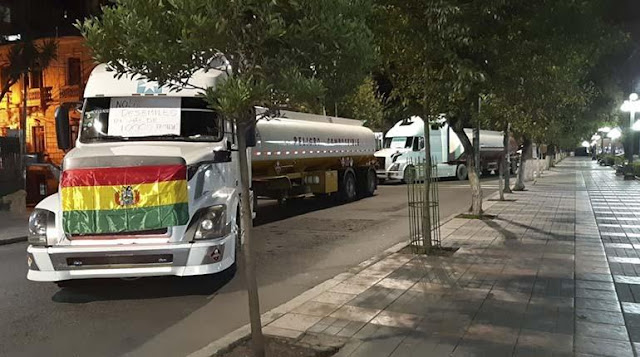
  Tanker drivers are blocking the central avenue 16 de Julio, in La Paz, to demand Yacimientos Petrolíferos Fiscales Bolivianos (YPFB) to cancel the contracting process that they qualify as "discriminatory" because it affects 1,000 direct jobs.

The road closures are being observed from Montes Avenue, in the vicinity of the Bolivian National Brewery (CBN), to the Plaza del Estudiante, at the end of El Prado, where fuel trucks were parked on the roads where public and private transport circulates, reported Página Siete.

"We are complying with this measure because we feel discriminated against by YPFB. They are leaving 1,000 families without work directly and more than 5,000 indirect jobs because of this discrimination we are suffering," said one of the protesters.

"We are really asking for the cancellation of this hiring, since we are leaving around 1,000 families without work, including drivers, mechanics and others," another driver told Unitel.

"There are more than 600 tanker truck drivers affected with this hiring process. We are small companies, drivers of families that have been affected and without jobs. The intention is not to harm public transport, but to dialogue with oilfields, from whom we hope that they will call us to dialogue", said another of those affected.

Protest against YPFB

Sunday, March 20, 2022

There are 81 airfields authorized by the DGAC and 90.1% operate in Santa Cruz.

 Of the 81 private airstrips distributed in Beni, Tarija, Santa Cruz and one in Potosí. Most of them are located in the department of Santa Cruz. 

There are 81 private airfields in Bolivia that are authorized to operate and are registered with the General Directorate of Civil Aeronautics (DGAC). Of the total, 90.1% are operating in the department of Santa Cruz and most are used by agribusiness and cattle ranchers. There is almost no control on the runways and all of them have the minimum requirements to operate. 

EL DEBER had access to the airfield records at the DGAC. In addition, in the documentation are the steps that must be fulfilled to enable a runway.

If a company or an individual wants to enable a runway somewhere in the country must initiate a series of procedures before the DGAC. The first step is to obtain a certificate of registration and operation of a private airfield from the DGAC. In this document, the state aeronautical agency authorizes the runway according to a series of inspections. This certificate is valid for five years and there are 81 now in full force and effect.

Then, the DGAC issues an administrative resolution detailing the inspection of the airfield. This inspection verifies the perimeter fence of the runway, access to the airfield and its maintenance, the length of the runway, signaling, indicator devices, whether there is a fire truck and whether night operations can be carried out.

Few companies or individuals comply with these measures. One of them is the San Cristóbal mining company, which enabled the Toldos airfield in the municipality of Colcha K, in the department of Potosí.

"By the Directorate of the National Aeronautical Registry, proceed with the renewal of the certification, qualification and consequent registration of the private aerodrome named 'Toldos', located in the Colcha K Municipality, Nor Lipez Province, Department of Potosí, with the following geographical coordinates: Latitude 21°10'8.59", Longitude 67°10'48.14", in the name of Empresa Minera San Cristóbal S.A., for a period of five (5) years computable from the issuance of this Administrative Resolution", says part of the enabling resolution for the Toldos aerodrome.

Thus, there are several runway registrations. 81 are in force, of which 14 expire their certificates this year. The DGAC allows the renewal of operations for another five years.   

More airfields

Santa Cruz concentrates most of the airfields in Bolivia. Seventy-three of the 81 nationwide are located in various areas of the Santa Cruz department. Most of them were built by livestock and agro-industrial entrepreneurs.  

In Santa Cruz, it was known that an anti-drug operation was carried out in one airfield, called Mundaka, in 2019. However, the then director of the Special Force against Drug Trafficking (Felcn), Maximiliano Dávila, now detained in the San Pedro de La Paz prison, ordered the results of the operation to be annulled.

Now, the Mundaka airfield is called Aeroparque La Cruceña. This airstrip, according to the registration certificate 023 is owned by Iber León Gorena and María Jesús León de Mundaka. It was registered in the 2021 management, but in 2014 the change of name was requested.

According to the DGAC constant inspections are made to private airfields in the country; however, there are no reports of the results of the visits to the 81 runways and only in the resolutions it is established that the aeronautical state will be able to verify the airfields without the need of permits.

Senator Centa Rek, of the Creemos alliance, announced that she will initiate a request for a written report to the Ministers of Government, Eduardo Del Castillo; and of Public Works, Edgar Montaño, so that they explain the types of controls that are carried out in the airfields, the controls to the flights and if the work of the anti-drug Police exists in these 81 airstrips.

The Creemos legislators have sent letters making these facts known to international organizations such as the European Union (EU) in Bolivia, the mission of the United Nations Office on Drugs and Crime (UNODC), the office of the Inter-American Drug Abuse Control Commission (CICAD), among others, because the fight against drug trafficking and drugs in Bolivia is not being carried out as it should and they are also responsible. They have to redirect their policies (of support) in the country, demand that there be certain controls", affirmed Senator Centa Rek.  

In the Movement Towards Socialism (MAS), they join the control of the airfields and ask the DGAC to carry out periodic inspections to the runways. "Of course there must be control of flights from any airport or airfield in the country. Work must be done to avoid the use of airstrips for drug trafficking and other crimes," said Congresswoman Gloria Quispe.

The mining company Paititi also has an airfield in the municipality of San José de Chiquitos. Its registration is valid and expires in 2024. There are other agricultural companies that also have their own airstrips, most of which are in Chiqutania.    
There are 81 airfields authorized

Study: drugs move between $US 2,000 MM and $US 2,500 MM per year

 An academic study sponsored by UAGRM's economics department and led by economist Alejandro Banegas estimates that drugs (cocaine and marijuana) generate a turnover equivalent to 5% of GDP.

A study, endorsed by the Universidad Autónoma Gabriel René Moreno (Uagrm), reveals that the economic movement of illicit drug activity generates an economic movement of between US$2 billion and US$2.5 billion per year in the country.

The study was prepared by Alejandro Banegas, former director of the Central Bank of Bolivia (BCB), and sponsored by the Uagrm, with the endorsement of its economics department. It will be published in a scientific journal.

The study aims to quantify and evaluate the importance of drugs, particularly cocaine and marijuana, in the Bolivian economy. It is also an experiment to determine what would happen if these drugs were legalized.

According to Banegas, there have been several approaches to the issue in the past.

For example, a study by Ricardo Rocha in 2001 came to quantify the illegal drug economy in Bolivia at 7% of GDP in the 1990s.

Subsequently, he said that in 2016 the Financial Investigations Unit (UIF) estimated that the illegal activity generated a movement of US$2.5 billion a year, or an equivalent to 8% of GDP.

Based on that background and the analysis of new variables, Banegas' study makes a more current approximation of the impact this has on the Bolivian economy.

"In terms of economic movement, we have estimated 5% of GDP, that is between 2,000 million and 2,500 million dollars. It is 5% with +0-1% as a confidence interval," he specified.

Two dimensions

The economist said that the impact of cocaine and marijuana is evaluated in the study from two dimensions.

On the one hand, the annual economic movement or flow and the other perspective seeks to establish how much is materialized in the economy as capital stock or patrimony. That is, how much of that movement has been transformed into houses, buildings and infrastructure via money laundering.

"Under that perspective, you have an annual economic flow of 5%. But in terms of capital, if you measure how these flows became houses and equity, we have estimated that this can have an impact of between 7% and 10% of GDP. This represents between US$2.8 billion to US$4 billion," Banegas pointed out.

To reach these estimates, the study took into account the potential production of drugs, which is a function of the number of hectares of coca leaf in excess.

It also analyzed the yield per hectare of surplus coca, the kilograms of coca paste obtained per hectare, and the domestic and foreign prices of the drug.

For this, police reports, United Nations documents and others were reviewed. "There are two variables that account for 95% of the explanation.  Seventy percent is due to surplus coca leaf crops and 25% is oriented to the price of the drug," said Banegas. He explained that of the 100% of cocaine production, 3% is consumed domestically and 97% is exported.

Drug legalization

Banegas indicated that the study addresses in a second part the impact that an eventual legalization of drugs, particularly marijuana, could have as a source of new tax collection. According to the economist, this could generate an effective fight against drug trafficking, because if it is legalized, the business is taken away from those who are dedicated to the illicit activity and the State can take more advantage of it.

"Legalizing the production and domestic consumption of marijuana could have revenues between 200 and 400 million dollars per year from taxes and this represents between 0.5% and 1% of GDP",he stressed.

Marijuana, feasible

Banegas said that the legalization of marijuana for domestic consumption is more feasible than other drugs. "In some countries there are certain states where it has been legalized and some grams of marijuana can be consumed. In Uruguay there is an exportable industry with certified hectares and where consumers must register," he said.

Banegas pointed out that in the Chiquitania region of Santa Cruz, crops could be certified for consumption, medicinal purposes or tourism.

He pointed out that the price of a kilo of marijuana is estimated at 100 dollars in Bolivia, but at the borders it goes up to 400 and even 800 dollars per kilo and if it were legalized, the potential income for the country would be significant. 

Analysts see impacts, but the country does not control surpluses

Economist Alberto Bonadona estimates that the drug circuit does not move more than 1 billion dollars, because the surplus is not controlled in the country.

"This has its weight in the economy, there are producers of coca, pisacocas and cocaine is produced, but it is in the export where more money is going to be earned. It leaves money in Bolivia, but not in the proportion that would be expected", the analyst pointed out.

According to Bonadona, the big mafias are not run by Bolivians, but by Colombians and Mexicans, who are the ones who appropriate most of the surplus in markets. "Bolivia should not exceed 1,000 million dollars, otherwise it would be observed in the economy, I do not think it would even exceed the flow of remittances," said Bonadona.

Economist Mike Gemio said that the money that originates in drugs is laundered into the economy with the exchange of goods and services. "When a vehicle is purchased, the importing company will issue an invoice and taxes will be paid, then the good can be sold, but the money enters the formal economy. In that way it enters the national accounts," he said.

The economist added that drug production and its weight in the economy is difficult to quantify, but some estimates can be made based on seizures, coca supply and surpluses generated.

drugs move between